
Follow an approved procedure
Use the equipment or component supplier retrofit instructions; do not rely on refrigerant pressure alone.

TRANSPORT & COMMERCIAL REFRIGERATION • A1
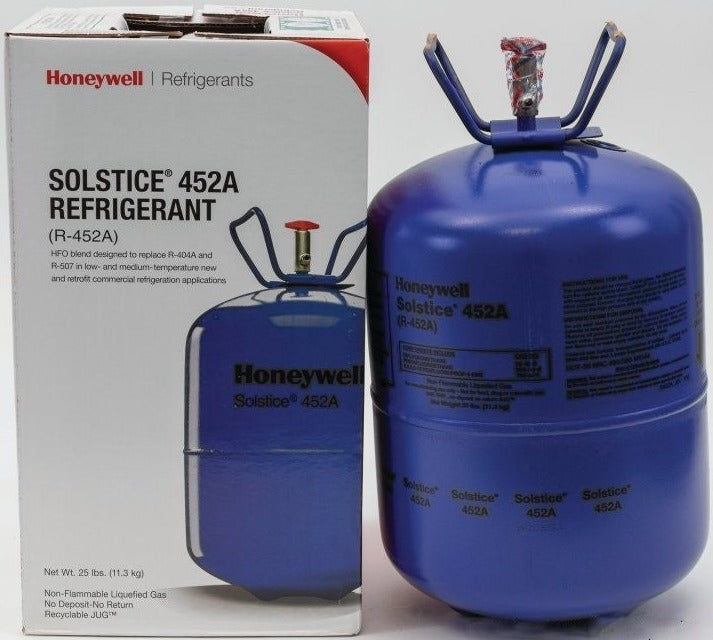
R452A combines HFC and HFO components for compatible low- and medium-temperature refrigeration. It is used in selected transport and remote-condensing applications and can serve as an engineered alternative to R404A or R507 where the equipment and retrofit procedure permit.
Clear identification matters. Compare these details with the equipment nameplate, service documentation and cylinder label before connecting service tools.
| Refrigerant designation | R452A |
|---|---|
| Refrigerant family | HFC / HFO blend |
| Blend composition by weight | R32 / R125 / R1234yf — 11% / 59% / 30% |
| Net refrigerant weight | 25 lb / 11.3 kg |
| Safety classification | A1 — lower toxicity, no flame propagation |
| Typical equipment | Approved transport, low-temperature and medium-temperature refrigeration |
| Lubricant guidance | POE lubricant is generally required; follow the equipment procedure |
| Charging characteristic | Zeotropic blend; charge as liquid |
Use the equipment or component supplier retrofit instructions; do not rely on refrigerant pressure alone.
R452A is a blend, so liquid removal is required to maintain its intended composition.
Confirm discharge temperature, superheat, subcooling and control response across the operating range.
Use only in approved R452A systems or documented retrofit applications. Do not mix with R404A, R507, R22 or any other refrigerant. Lubricant, expansion device and control compatibility must be confirmed before conversion.
Bulk refrigerant sales in the United States are restricted. Proof of the applicable Section 608 or Section 609 technician certification—or documentation that the purchaser employs a properly certified technician—may be required before fulfillment. The purchaser is responsible for satisfying federal, state and local rules for purchase, transport, storage and use.
Store upright and secured in a cool, dry, ventilated place. Protect the cylinder and valve from excessive heat, sunlight and impact. Follow the label and safety data sheet. Refrigerant can displace oxygen, cause cold burns and create dangerous pressure if mishandled. Never intentionally vent refrigerant.

