
Recover the old charge
Do not top off R22 with R422B. Recover the existing refrigerant completely before conversion.

R22 RETROFIT OPTION • A1
R422B is an HFC-based blend developed to approximate R22 performance in certain direct-expansion air-conditioning applications. Its small hydrocarbon component can assist oil return in some mineral-oil or alkylbenzene systems, but every conversion still requires a professional system review.
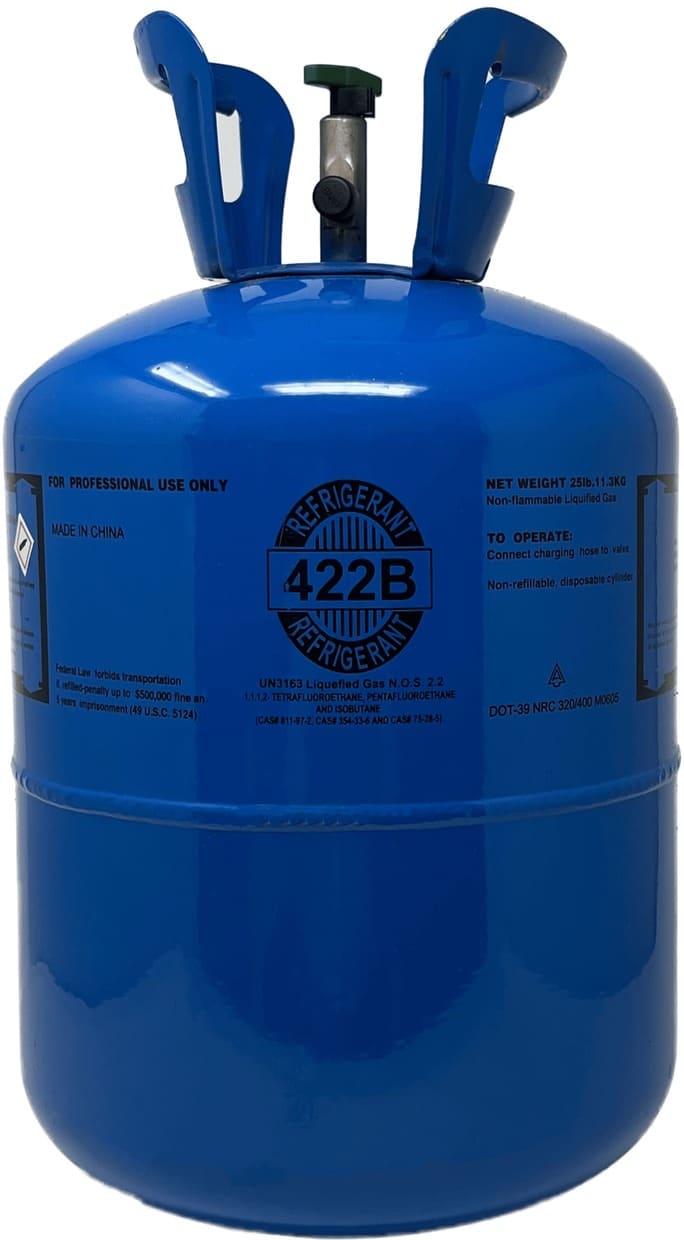
Clear identification matters. Compare these details with the equipment nameplate, service documentation and cylinder label before connecting service tools.
| Refrigerant designation | R422B |
|---|---|
| Refrigerant family | HFC blend with hydrocarbon component |
| Blend composition by weight | R125 / R134a / R600a — 55% / 42% / 3% |
| Net refrigerant weight | 25 lb / 11.3 kg |
| Safety classification | A1 — lower toxicity, no flame propagation as formulated |
| Typical equipment | Evaluated R22 air-conditioning retrofit applications |
| Charging characteristic | Zeotropic blend; liquid charging required |
| Intended user | Qualified HVAC/R professionals |
Do not top off R22 with R422B. Recover the existing refrigerant completely before conversion.
Preserve the formulated blend by removing liquid from the cylinder and metering it according to accepted procedure.
Check operating pressures, temperatures, superheat, subcooling and oil return, then relabel the system.
R422B is a retrofit option, not a universal drop-in. A slight capacity change may occur. System design, piping, oil, metering and controls must be evaluated before use, and R422B must never be mixed with R22 or another refrigerant.
Bulk refrigerant sales in the United States are restricted. Proof of the applicable Section 608 or Section 609 technician certification—or documentation that the purchaser employs a properly certified technician—may be required before fulfillment. The purchaser is responsible for satisfying federal, state and local rules for purchase, transport, storage and use.
Keep the cylinder upright, capped and secured in a cool, dry, ventilated space. Avoid high heat and physical damage, and consult the current safety data sheet before handling. Refrigerant can displace oxygen, cause cold burns and create dangerous pressure if mishandled. Never intentionally vent refrigerant.

